 info@goodhopetutoring.com
 +1-301-717-8046




The essay prompt is right there. The timer starts. And instead of writing, most students freeze.
Not because they are bad writers. Because nobody taught them a process for writing under pressure. They know how to write when they have three days, a library, and the ability to reread their drafts. Timed essays take a completely different skill set, and it is one that can absolutely be learned and practiced.
These are the strategies that consistently work — for in-class essays, AP free-response questions, ACT writing sections, and any assignment where a student needs to produce strong writing fast.
The Real Problem With Timed Essays
Most students approach a timed essay the same way they approach regular writing: they read the prompt, start forming ideas, and begin writing once a sentence appears in their head. That approach fails under pressure for one simple reason.
Writing and thinking at the same time is inefficient. The brain can only do one thing well. Students who try to figure out their argument as they write end up with vague opening paragraphs, arguments that shift midway through, and conclusions that contradict their thesis. The essay becomes harder to write the further in they get.
University of Waterloo's Writing and Communication Centre identifies this as the most common timed essay mistake: starting to write before the thinking is done, then spending the rest of the essay trying to catch up to a clear point.
The fix is a planning phase that feels counterintuitive but saves more time than it costs.
Step 1: Read the Prompt Like It Is the Most Important Sentence on the Page (Because It Is!)
Before any writing, before any brainstorming, read the prompt twice. Not once. Twice!
Underline the instruction words: analyze, argue, compare, explain, evaluate. These words tell the student exactly what kind of thinking the essay requires. An essay that describes when it was asked to analyze will lose points regardless of how well it is written. An essay that argues a position when asked to compare two things is answering the wrong question.
Duke University's Writing and Teaching Program recommends rewriting the prompt in your own words before writing anything else. That one step forces real comprehension and catches misreadings before they turn into a 400-word mistake.
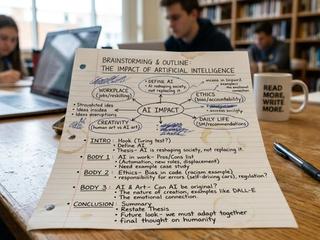
Step 2: Spend the First 10% of Your Time Planning, Not Writing
For a 45-minute essay, that is four to five minutes. For a 30-minute essay, three minutes. Students resist this because it feels like lost time. It is the opposite.
North Avenue Education's research on timed writing practice confirms that students who outline before they write produce more organized, higher-scoring essays than those who start immediately, even when controlling for total writing time. The outline does not need to be detailed. It needs to answer three questions:
- What is my main argument in one sentence?
- What are my two or three supporting points?
- What evidence or example supports each point?
Write the answers down. Do not start drafting until those three questions have answers. That outline becomes the skeleton of the essay, and the writing becomes the process of putting flesh on bones rather than trying to build both at once.
Step 3: Write a Thesis First, and Make It Do Real Work
The thesis is not a restatement of the prompt. It is the student's specific answer to the question the prompt is asking.
Weak thesis: Social media has both positive and negative effects on teenagers.
Strong thesis: Social media worsens adolescent mental health primarily through social comparison, sleep disruption, and reduced face-to-face interaction.
The strong version tells the reader exactly what the essay will argue and in what order. It also gives the student a built-in outline: each phrase in the thesis becomes a body paragraph. A specific, arguable thesis is the single fastest way to make an essay feel organized, even when time is tight.
According to the Quora answer from a former SAT essay instructor, the most common scoring failure in timed essays is not bad grammar or weak evidence. It is an essay that wanders because the thesis was vague. Graders use the thesis as a map. If the map is unclear, the essay reads as unclear, regardless of the content.
Step 4: Structure Every Body Paragraph the Same Way
Under time pressure, students do not need to write beautifully. They need to write clearly. A consistent paragraph structure makes both possible.
Every body paragraph should follow this sequence:
Topic sentence — States the point this paragraph makes in relation to the thesis.
Evidence or example — A specific fact, quote, event, or example that supports the point.
Explanation — How and why the evidence supports the argument. This is the most important part and the one students most often skip.
Transition — A phrase that connects this paragraph to the next.
Students often make the mistake of listing evidence without explanation. Graders do not want to be shown examples — they want to see the student's thinking about why those examples matter. Two well-explained points score higher than four undeveloped ones every time.
For students who want to build stronger foundational writing habits before test day, effective prewriting activities are a practical starting point. The skills practiced in prewriting transfer directly to the planning phase of timed essays.
Step 5: Manage the Clock Like It Is Part of the Test
Because it is!
A rough time breakdown for a 45-minute timed essay:
- Minutes 1 to 5: Read prompt, plan, write thesis and outline
- Minutes 5 to 35: Write introduction and all body paragraphs
- Minutes 35 to 42: Write conclusion
- Minutes 42 to 45: Reread thesis and first sentences of each paragraph, fix obvious errors
The most common time management mistake is spending too long on one section and running out of time for the conclusion. A weak conclusion hurts less than a missing one. Students who feel themselves writing too slowly at minute 25 should cut planned detail from remaining paragraphs rather than skip a section entirely. A shorter but complete essay scores significantly better than an elaborate but unfinished one.
One counterintuitive rule from University of Waterloo's timed essay guidance: do not stop to edit each paragraph as you finish it. Write the whole essay first, then revise at the end. Mid-essay editing is the single biggest time thief in timed writing and almost always produces less improvement than finishing the draft and revising with a fresh perspective in the final minutes.
Step 6: Choose the Argument You Can Defend Best, Not the One You Believe
This one surprises students. On a prompt that asks them to argue a position, the right choice is not the position they actually hold. It is the position they have the most evidence for.
As a former SAT essay teacher notes, the grader is not scoring honesty or moral alignment. They are scoring the quality of reasoning and evidence. A student who argues a position they find less personally convincing but can support with three specific, well-explained examples will outscore a student arguing their genuine view with vague, unsupported claims every time.
Choosing the more defensible side also reduces anxiety. Writing from a position of "I have things to say about this" feels very different from writing from a position of "I believe this strongly but don't know how to prove it."
How to Build This Skill Before Test Day
Timed essay writing is a skill. Like any skill, it improves with deliberate practice, not by reading about it.
College Prep Genius recommends writing at least ten timed essays before a major exam, using real past prompts from AP, ACT, or in-class essay banks, with the actual time limit running. Not twelve minutes over. Exactly on time. The discomfort of the real constraint is what the practice is building tolerance for.
After each practice essay, the student should answer two questions: Did the thesis do real work? Did every paragraph connect back to it? Those two checks cover the majority of the structural problems that cost points on timed essays.
For students preparing for standardized tests specifically, pairing this essay work with broader test prep is worth considering. How to prepare your child for standardized tests covers the full picture, and three effective ways of memorizing information for a test is useful for students who struggle to recall examples and evidence quickly under pressure.
The Bottom Line
Strong timed essays are not the product of faster thinking or better vocabulary. They come from a repeatable process: read carefully, plan briefly, write a real thesis, structure each paragraph, and protect the clock.
Students who practice this process ten times before their AP exam or in-class test will perform better than students who have written fifty untimed essays and assumed the skill would transfer. It does not transfer automatically. It has to be practiced under the same conditions.
If your student struggles with writing under pressure specifically, and you want structured support building both the skills and the confidence to perform, our tutors at Good Hope Tutoring Services work with students on exactly this. We serve students in the DMV area in person and nationally through virtual sessions.
Sources